
Single atom transistor gets precise position on chip

The basic unit of matter could become the basic unit of computing. A lone atom of phosphorus embedded in a sheet of silicon has been made to act as a transistor. (from newscientist1.blogspot.de)
It is not the first single-atom transistor, but it can be much more precisely positioned than its predecessors, potentially making it a lot more useful.
“It’s an absolutely fantastic piece of engineering,” says physicist Bruce Kane at the University of Maryland, who was not involved in the work.
Elaborate production methods would initially prevent single-atom phosphorus transistors from being a worthwhile addition to traditional computers, but they may be necessary one day. The devices could also find an application in futuristic, super-speedy quantum computers.
A transistor is essentially a lump of conducting material sitting between two electrodes that acts as a switch. A pulse of voltage is supplied by a further electrode,”opening” the switch and allowing current to flow through the transistor.

Wiggling atom

Combining transistors on a chip produces logic circuits that can carry out computations. A goal shared by computer chip makers is to keep shrinking the transistor: squeeze ever more onto a single chip and you increase its computational power.
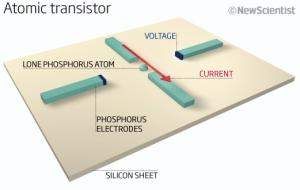
To dictate the exact position of their single atom, Michelle Simmons at the University of New South Wales, Australia, and colleagues started by covering a silicon sheet with a layer of hydrogen. Then they used the tip of a scanning tunnelling microscope to remove hydrogen atoms according to a precise pattern. They exposed two perpendicular pairs of exposed silicon strips plus a tiny rectangle made of just six silicon atoms that sat at the junction between these strips (see diagram, right).
Adding phosphine gas (PH3) and heating caused phosphorus atoms, which are conducting, to bind to these exposed areas of silicon. In the case of the rectangle only one atom inserted itself into the silicon network.
The result was four phosphorus electrodes and a single phosphorus atom.

Boutique operation

One pair of electrodes was separated by a 108-nanometre gap. Creating a voltage between them allowed current to flow between the two perpendicular electrodes – separated from each other by just 20 nanometres, through the single phosphorus atom, which acted as a transistor.
Kane points out that the atomic transistor works at temperatures below 1 kelvin and that fabrication is difficult. “It’s a very slow, boutique operation to make one of these,” he says.
Simmons agrees, but counters that the traditional computer makers may be forced to adopt this technology if they want to make ever smaller chips. “This is one of the only techniques that allows you to make single atom devices,” she says.
Physicist Jeremy Levy of the University of Pittsburgh in Pennsylvania reckons the future of single atom transistors lies in quantum computers. The spin of the electrons in isolated phosphorus atoms could serve as qubits, the quantum equivalent of the bits in today’s computers. Controlling the interaction between qubits requires knowing the exact location of each one. Now that the location of individual atoms can be controlled, the next challenge is to link two of these transistors, Levy says.

Desertec projects moves beyond planning stage

European and North African governments have ushered in a new implementation phase of an ambitious green energy project called Desertec. It hopes to bring renewable energy from Africa to Europe. (from dw.de)

A number of governments in Europe and North Africa have redoubled their efforts to finally get an ambitious green energy project off the ground, Germany’s daily “Süddeutsche Zeitung” reported on Wednesday.

France and Germany, whose Desertec Industry Initiative aims to source future European energy supplies from solar and wind power produced in the deserts of North Africa and the Middle East, have been important financial supporters in the initial phase.

The two nations have been joined by Spain, Italy and Morocco for intensive talks on letting the project finally take shape. According to newspaper reports, negotiations are under way on building a 600-million-euro ($778 million) solar power station in Morocco which is to transport energy to the European mainland.

Pilot project

The “Süddeutsche Zeitung” said a corresponding declaration of intent would be signed as early as November this year. It added that a government-level multinational agreement would be inked in the first half of 2013, quoting Morocco’s Industry Minister, Abdelkader Amara.

Desertec Chief Paul van Son stated the solar power plant in question would be built between 2014 and 2016 and would eventually have a capacity of 150 Megawatts.

The project will be co-financed by industry, national governments and international energy organizations. Nations other than those already involved in the scheme would be welcome to join in the process, the industry initiative said.

What is the Smallest Star?

The biggest stars in the Universe are the monster red hypergiants, measuring up to 1,500 times the size of the Sun. But what are the smallest stars in the Universe? (from universetoday.com)

The smallest stars around are the tiny red dwarfs. These are stars with 50% the mass of the Sun and smaller. In fact, the least massive red dwarf has 7.5% the mass of the Sun. Even at this smallest size, a star has the temperature and pressures in its core so that nuclear fusion reactions can take place.
Remove this ad

One example of red dwarf star is the closest star to Earth, Proxima Centauri, located just 4.2 light-years away. Proxima Centauri has 12% the mass of the Sun, and it’s estimated to be just 14.5% the size of the Sun. The diameter of Proxima Centauri is about 200,000 km. Just for comparison, the diameter of Jupiter is 143,000 km, so Proxima Centauri is only a little larger than Jupiter.

But that’s not the smallest star ever discovered.

The smallest known star right now is OGLE-TR-122b, a red dwarf star that’s part of a binary stellar system. This red dwarf the smallest star to ever have its radius accurately measured; 0.12 solar radii. This works out to be 167,000 km. That’s only 20% larger than Jupiter. You might be surprised to know that OGLE-TR-122b has 100 times the mass of Jupiter, but it’s only a little larger.

And that is the smallest known star. But there are certainly smaller stars out there. The smallest theoretical mass for a star to support nuclear fusion is 0.07 or 0.08 solar masses, so smaller stars are out there.

The Loongson Low Power MIPS Processesor

Loongson is a general purpose RISC processor. It is a 64-bit MIPS compatible processor, which is patented by MIPS Technologies. The silicon is designed by ICT/CAS China and manufactured by ST Microelectronics. The online retail price for Loongson-2F chip is about USD30~40, which is available from the Lemote’s online shop. Of course, you can order it in the name of STLS2F from ST as well.
(from dev.emcelettronica.com)

Loongson-2F, the latest version operates at 1.2 to 1.5GHz and only consumes 5 watts. Additionally, Loongson-2F also supports DDR2 and USB2.0. As a RISC processor, Loongson processor is struggling on its way to the market for a long time. As we know, the processor market is highly competitive. ARM has been a de facto standard RISC processor IP in mobile terminals and embedded SoC. MIPS is not the market leader. It is mainly used in digital video and telecommunication segments like STB, HDTV, IPTV, DSL modem, laser print and video game consoles (Sony PS/PSP). MIPS processors are usually available in IP and embedded SoC, you can find some old types available for legacy SGI workstation, Windows CE PPC and HPC. AMD acquired Alchemy MIPS processor in PMP and HDTV, and finally it got rid of this business line before long. Sometimes, I wonder why AMD bought Alchemy at the very beginning.

Although it is hard to find the market opportunities for MIPS. ICT offers a series of open source MIPS based designs for NAS, Linux desktop PC, thin client terminal and others with their own Loongson processor family. Recently, they start to promote the MIPS Netbook to the consumer market. The price is comparable to the ATOM/Nano based Netbook, many local Linux developers enjoy it very much. Because it is very hard to buy a high speed MIPS board with low price. Can you find a 300USD evaluation board for 1.5GHz MIPS processor? The system has been installed with Debian MIPS distribution and native GCC for MIPS. Compare to an ordinary x86 Netbook, the user experience is same. MIPS still have major OS support from Windows CE and Linux. Most of the popular software components are available on these platforms. Netbook and MID are great chances for MIPS to return to the desktop/mobile computing market. However, I can name many limitations for MIPS: you can not play Real Video and QuickTime, you can not run WINE, you can not use commercial DLLs for x86 and Windows, and you may face to the driver issues. The MIPS Netbook only fits the requirements for the highly experienced communities or the people who have no PC experiences at all (like my parents) and just want to check their emails or browsing. The MIPS device is good for them because it is totally virus-free.

I don’t want to promote MIPS IP or Loongson Netbook here. I also don’t think MIPS Netbook can win the market. Non-x86 structure can not beat x86 in Netbook, because people consider Netbook a low-cost laptop PC. However MIPS should focus its advantage on digital video segments, including media adapter, PMP and PND. And so we, as the engineers, let us check the specification and find out its opportunities.

– MIPS-III 64 bit superscalar architecture
– 900 MHz clock frequency
– Single/double precision floating point units
– New streaming multimedia instruction set support (SIMD)
– 64 KB I-cache, 64KB D-cache, on-chip 512 KB unified L2 cache
– On chip DDR2 667 and PCI-X controller
– 4W@900MHz power consumption:
– Voltage/frequency scaling
– Standby mode support
– L2 cache disable/enable option
– 90 nm process technology
– JTAG interface

Apparently, this chip has advantage on 64-bit performance, FPU, SIMD over mainstream ARM products. Meanwhile it has much lower power consumption over x86 processor. It requires 3rd party north/south bridges (VIA) to complete the system design. A Chinese company HiSand also developed a Loongson-1 based SoC for Internet Radio, digital photo frame and other consumer products. Its HS3210 has integrated a lot of peripherals on-chip with a 266MHz MIPS core. It is the first step of the right direction. Only if its MIPS SoC wins the market, the Loongson can live on. I have no doubt about the market capacity of consumer electronics, if HS3210 has good quality with low price as they claimed, it is make sense to buy a Loongson computer/Netbook for development purpose with the native toolchains. Loongson also offers a simulator so you can evaluate the system.

Reference

Loongson – Wikipedia

http://en.wikipedia.org/wiki/Loongson

Loongson Official Site, in Chinese
http://www.loongson.cn/

A French company EMTEC released its Loongson based subnotebook under the brand name Gdium. The Mandriva G Linux is pre-installed in a USB key. It is available in Europe, China and US.
http://www.gdium.com/

The Chinese manufacturer Lemote offers new 8.9″ Netbook, running Debian GUN/Linux, available in Europe at the Dutch company Tekmote Electronics.
http://www.lemote.com/english/index.html

Datasheet of 2F from ST Electronics
Datasheet ST
http://www.st.com/stonline/products/literature/ds/14793/stls2f02.pdf

HiSand IC Design Inc,.
http://www.hisand.cn/

NASA Statement On Alpha Centauri Planet Discovery

WASHINGTON — The following is a statement about the European Southern Observatory’s latest exoplanet discovery from NASA’s Science Mission Directorate Associate Administrator, Dr. John Grunsfeld. (from nasa.gov release : 12-366)

“We congratulate the European Southern Observatory team for making this exciting new exoplanet discovery. For astronomers, the search for exoplanets helps us understand our place in the universe and determine whether Earth is unique in supporting life or if it is just one member of a large community of habitable worlds. NASA has several current and future missions that will continue in this search.

An example [sic] is NASA’s Kepler mission. It was specifically designed to survey a specific region of our Milky Way galaxy to detect Earth-size and smaller planets in or near the habitable zone — that region around a star where it is theoretically possible for a planet to maintain liquid water on its surface — and determine the fraction of the hundreds of billions of stars in our galaxy that might have such planets. Kepler works very differently from HARPS. Rather than detecting the wobble in the host star, Kepler detects the slight dimming of a star when a planet passes in front of it.

NASA’s Hubble and Spitzer space telescopes have contributed to the study of exoplanets. Using their photometric and spectroscopic sensitivity, these space telescopes have made the first steps in characterizing the atmospheres of planets around other stars. They can only do this when the exoplanets pass serendipitously in front of its star, allowing the space telescope to study light that has filtered through the planet’s atmosphere.

NASA’s James Webb Space Telescope (JWST) will provide a unique facility that will serve through the next decade as the mainstay for characterization of transiting exoplanets. The main transit studies JWST will be able to undertake are: discovery of unseen planets, determining exoplanet properties like mass, radius, and physical structure, and characterizing exoplanet atmospheres to determine things like their temperature and weather. If there are other planets in the Alpha Centauri system farther from the star, JWST may be able to detect them as well through imaging.

NASA is also studying two medium-class exoplanet missions in our Explorer program, and in the spring of 2013 will select one of them to enter development for flight later in the decade.”

(editor’s note: faster engines are needed, init? )

Clinton Forbids Funding of Human Clone Studies (05.03.1997)

Warning against the temptation “to play God,” President Clinton yesterday banned federal funding of human cloning research and asked privately funded scientists to halt such work until a national bioethics commission reviews what he called the “troubling” legal and ethical implications.

By Rick Weiss
Washington Post Staff Writer
Wednesday, March 5, 1997; Page A10

“Each human life is unique, born of a miracle that reaches beyond laboratory science,” Clinton said during a brief ceremony in the Oval Office, where he announced his executive directive. “I believe we must respect this profound gift and resist the temptation to replicate ourselves.”

The president’s order, effective immediately, comes 10 days after Scottish scientists reported they had cloned a sheep named Dolly from adult cells and two days after researchers in Oregon revealed they had bred a pair of rhesus monkeys from cloned embryo cells.

In 1994, Clinton signed an executive order banning federal funding of certain kinds of research involving human embryos, and Congress has prohibited other kinds of human embryo research. However, said Clinton yesterday, “after reviewing these restrictions, our administration believes that there are loopholes that could allow the cloning of human beings if the technology were developed.”

The president acknowledged that much of the cloning-related research in this country is conducted by private companies not covered by the federal ban. Some biotechnology companies are trying to clone pigs with humanized organs for transplantation into people, for example, and other companies have cloned goats that make human medicines in their milk. Clinton said he supported continued research in animals, but he asked companies to impose upon themselves a “voluntary moratorium” on expanding that work to humans.

“Any discovery that touches upon human creation is not simply a matter of scientific inquiry. It is a matter of morality and spirituality as well,” Clinton said. “That is why I am urging the entire scientific community — every foundation, every university, every industry that supports work in this area — to heed the federal government’s example.”

Highlighting the ban’s importance, Clinton made the announcement flanked by Vice President Gore, Health and Human Services Secretary Donna E. Shalala, National Institutes of Health Director Harold E. Varmus, presidential science adviser Jack Gibbons and Princeton President Harold T. Shapiro, who chairs the National Bioethics Advisory Commission. That commission is scheduled to meet at the Watergate Hotel on March 13 and 14 to discuss the ethics of human cloning and has been asked by the president to submit a final report on the issue by the end of May.

Many scientists, including those involved in cloning research, have insisted repeatedly during the past week that they have no interest in cloning humans, even if it were technically possible. After hearing of the president’s ban, several reiterated those feelings.

“The president’s reaction is a prudent one and is fully appropriate, and speaking for the industry, we support him wholeheartedly,” said Carl B. Feldbaum, president of the Biotechnology Industry Organization, which represents 700 biotechnology companies and institutions.

Feldbaum said it was understandable that Clinton, and probably much of the public, felt a need to put the brakes on the quickly evolving scientific field. “You go from cloning of sheep a week ago and you cloned monkeys this week and you figure humans have got to be cloned by next week,” he said.

Feldbaum said he was heartened, however, to see Varmus by Clinton’s side in the Oval Office — an arrangement he said indicated Clinton’s ongoing support for basic research on embryos, which could lead to improved treatments for infertility and other medical problems.

Colin Stewart, a researcher at the National Cancer Institute’s research center in Frederick, Md., said he too was encouraged by Clinton’s apparent effort not to reject all genetics research as he placed limits on human cloning.

“What I’ve been encouraged by in all this has been the level of debate and the high level of consciousness of what’s going on,” Stewart said, “and I hope this won’t stymie debate about long-term policy on human embryos and other forms of mammalian research.”

Rep. Constance A. Morella (R-Md.), whose district includes the NIH, has called for the first congressional hearings on cloning, to be held this afternoon in the Rayburn House Office Building. Scheduled speakers include Varmus, Case Western Reserve University bioethicist Thomas H. Murray; M. Susan Smith, director of the Oregon research center where the monkeys were cloned; and James Geraghty, president of Genzyme Transgenics, a Massachusetts company that has produced goats from cloned embryos.

Sen. Bill Frist (R-Tenn.) announced yesterday that his hearings on cloning, scheduled for next Wednesday in the Dirksen Senate Building, will include testimony from Ian Wilmut, the Scottish researcher who oversaw the cloning of Dolly.