New solid-state material from Kyushu University turns visible light into high-energy UV at sunlight intensity, expanding solar energy potential (from www.kyushu-u.ac.jp)
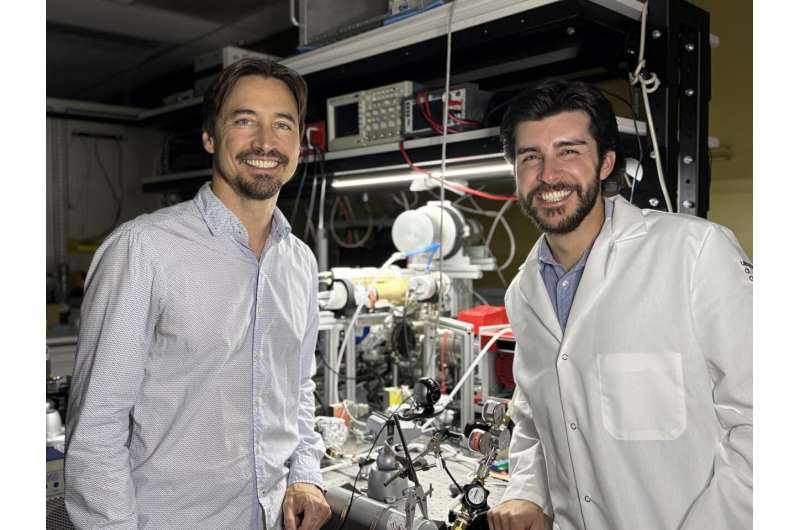
Associate Professor Yoichi Sasaki
Faculty of Engineering
Fukuoka, Japan—Two cups of warm water don’t make one cup of boiling water. But in the quantum world, multiple low-energy photons can combine to produce a single, higher-energy photon.
A research team at Kyushu University has developed a solid-state molecular material that “upgrades” visible light into ultraviolet (UV) light under ordinary outdoor sunlight, achieving a conversion efficiency of 1.9%. The study was published in Nature Communications (doi.org/10.1038/s41467-026-73898-0) on June 23.
Harsh UV light is something most people try to avoid in summer, yet it is indispensable across fields ranging from air purification and resin curing in 3D printing to gel hardening in dental fillings and nail art. Despite its importance, UV accounts for only about 6% of the sunlight reaching Earth’s surface, with only a fraction of that being practically usable.
“What we do here is ‘add together’ the energy from two visible light photons to make one ultraviolet photon. It’s a fascinating process called photo upconversion,” explains Yoichi Sasaki, Associate Professor at Kyushu University’s Faculty of Engineering and the study’s corresponding author.
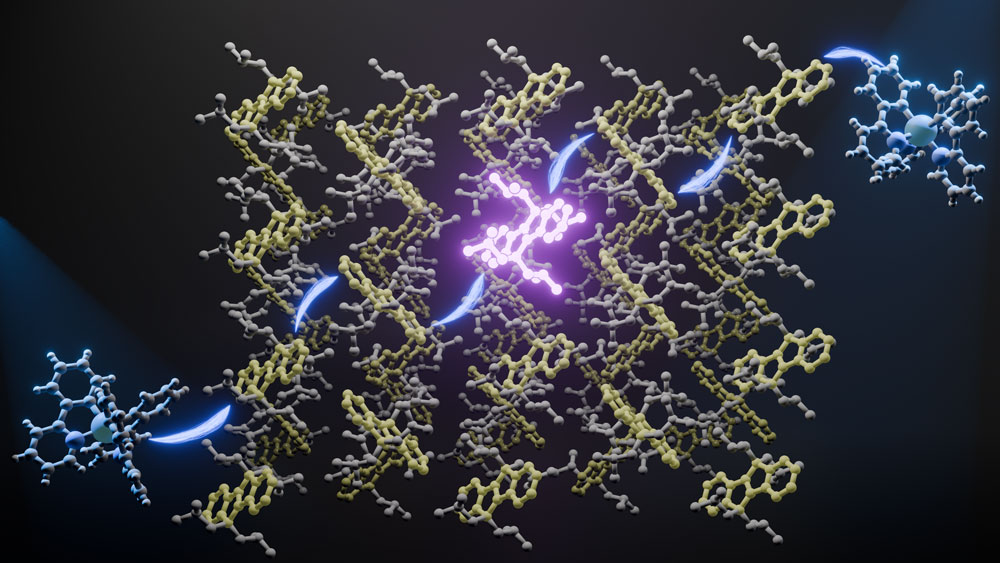
One mechanism that enables such upconversion is triplet-triplet annihilation (TTA). A “donor” molecule absorbs visible light and excites its electrons into a high-energy triplet state, then passes it to a neighboring “acceptor” molecule. When two triplets meet, they annihilate each other, releasing their combined energy as a UV photon. TTA works well in liquids, where molecules move freely, and triplets collide easily. But those systems often rely on toxic solvents and can evaporate, limiting their practical use. That is why scientists have long searched for solid alternatives.
“In solids, molecules are packed tightly, and the π electron clouds—regions of high electron density hovering above and below each molecular plane—can overlap,” says Sasaki. “When that happens, triplets easily fizzle out before they ever meet. Molecules must be close enough for energy to transfer but separated enough to prevent quenching of excitons.”
The team found their answer in an organic semiconductor called dihydroindenoindenedene (DHI). By attaching alkyl chains to DHI’s sp³ carbon atoms—which have four bonds pointing in fixed 3D directions—the researchers created precisely controlled gaps between neighboring molecules, keeping them close enough for energy transfer without unwanted strong electronic interaction.
The optimized material shows strong light emission, long-lived excited states, and efficient energy transfer, achieving a solid-state fluorescence quantum yield above 60%. With a donor molecule, the system reaches an upconversion efficiency of 1.9%.
“This means roughly two UV photons are produced for every hundred visible-light photons absorbed,” Sasaki adds. “It may sound low, but it runs on natural sunlight alone. Most solid-state materials cannot realize this even at much higher light intensity.”
The material has been filed for a patent. Beyond efficiency, it offers advantages for real-world use, including straightforward synthesis and low-cost starting materials. The team sees potential applications in solar-driven photocatalysis, indoor air purification, and low-intensity 3D printing.
For the research team, the work also carries personal weight.
In 2012, Nobuo Kimizuka, now Professor Emeritus at Kyushu University’s Research Center for Negative Emissions Technologies, pioneered research into photon upconversion via triplet energy migration in self-assemblies, seeking to establish a molecular systems chemistry where self-assembly performs useful functions. His team made steady progress in both solution and gel systems, yet developing efficient solid-state upconversion systems remained challenging. A breakthrough finally came in May 2024, less than a year before Kimizuka’s retirement.
What followed was a sprint driven as much by shared bonds and gratitude as by science. At that time, graduate students Naoyuki Harada, Hayato Shoyama, Nutnicha Boonmong, along with then-Assistant Professor Kiichi Mizukami of Kyushu University’s Faculty of Engineering, worked alongside Sasaki to compress years of work into one.
“We handed the draft to Professor Kimizuka just 11 days before he left the lab, which for us felt like a heartfelt retirement gift,” Sasaki notes.
“This discovery is the culmination of over 14 years of our research and marks a major milestone in photon-upconversion and molecular self-assembly research,” concludes Kimizuka.
###
For more information about this research, see “Sterically Protected π-Electron Systems for Efficient Solid-State Photon Upconversion,” Naoyuki Harada, Hayato Shoyama, Nutnicha Boonmong, Kiichi Mizukami, Yuya Watanabe, Pei Zhao, Masahiro Ehara, Yoichi Sasaki, Nobuo Kimizuka, Nature Communications, https://doi.org/10.1038/s41467-026-73898-0